NUS / KOPI & CO / BMS5212
What can this evidence support?
From three prototype screens back to three management questions. Inspect what the evidence supports, then prepare a more specific set of questions for the next step.
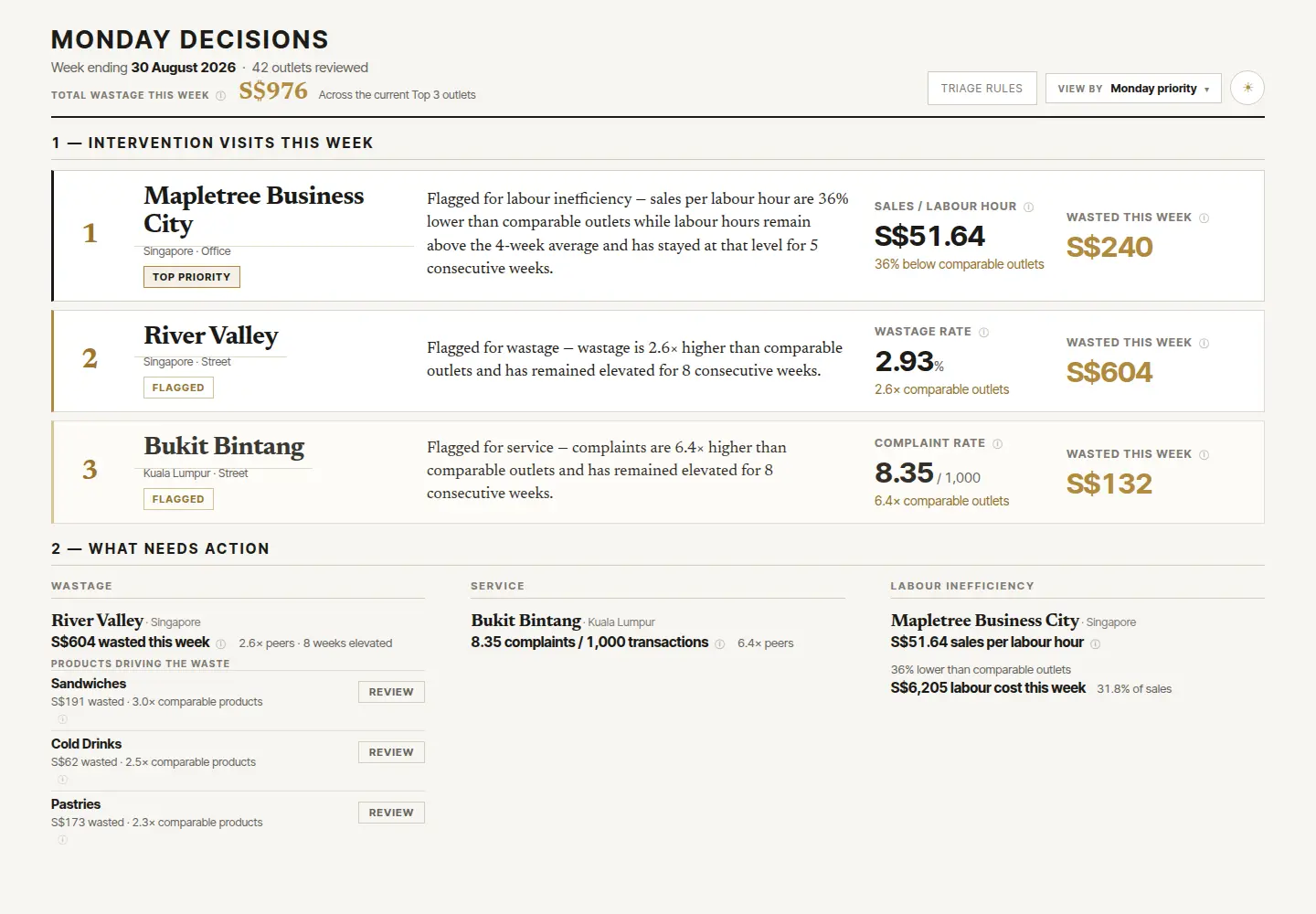
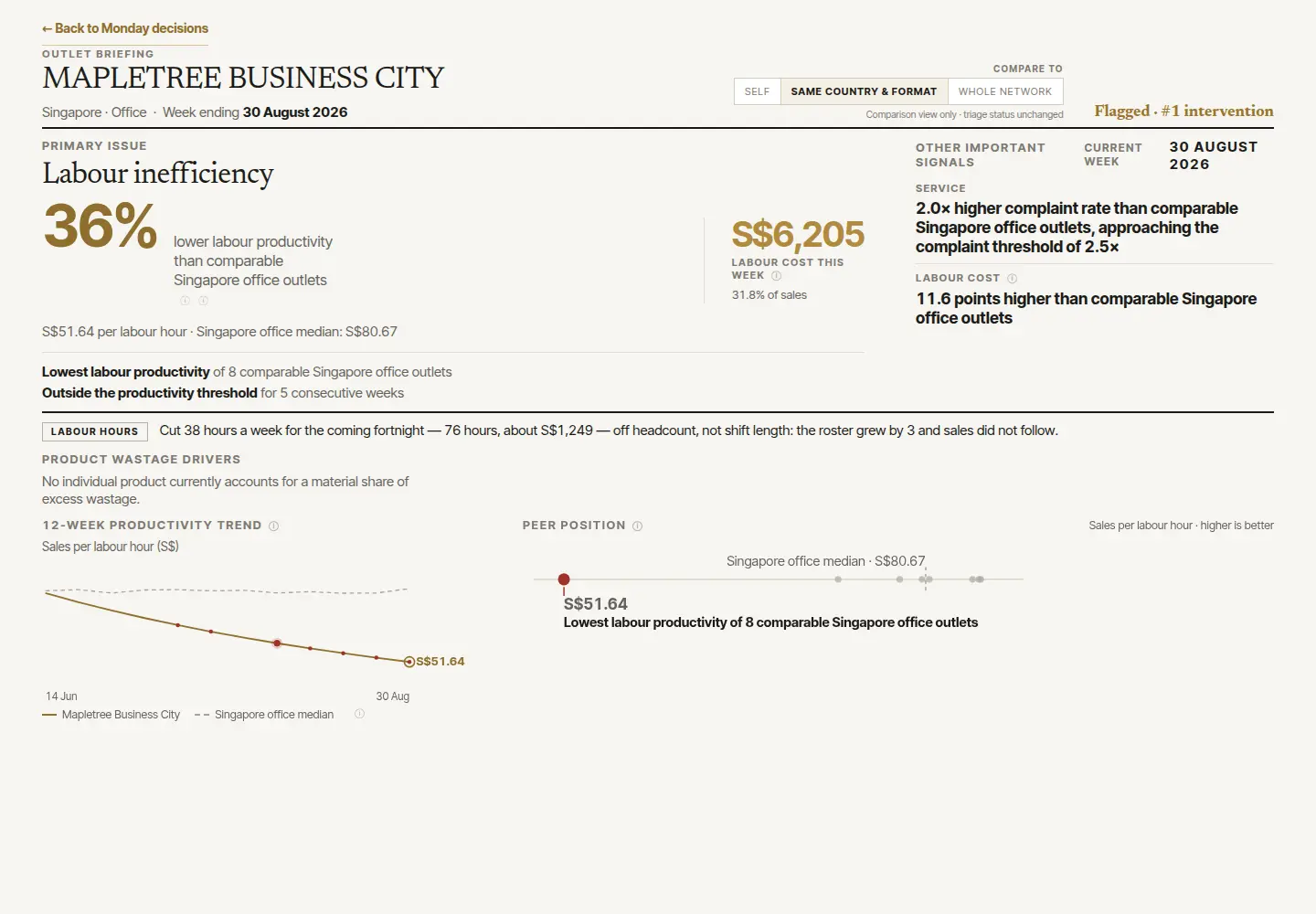
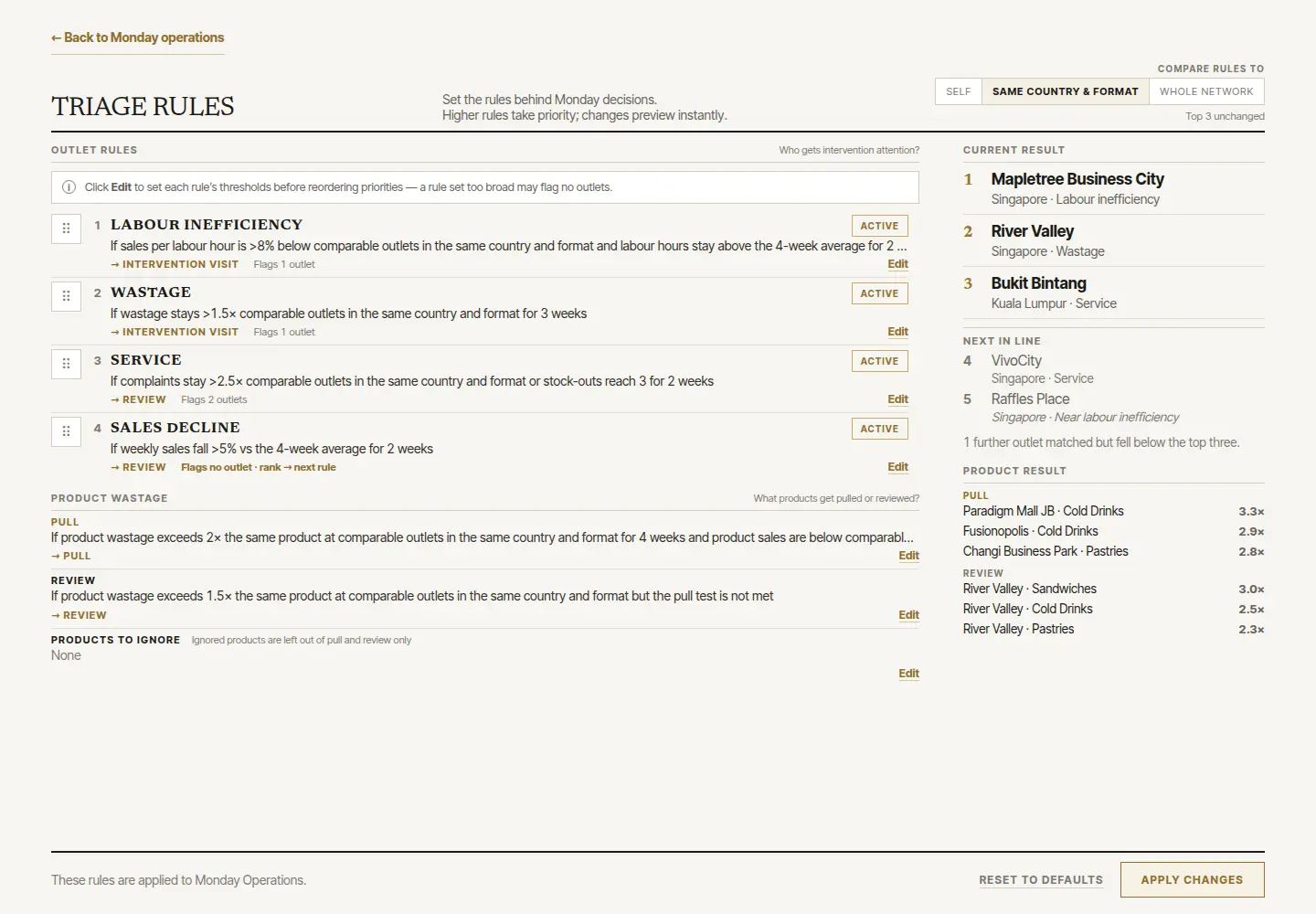
01 / A PROJECT, THEN A PERSONAL REFLECTION
Return to the question behind the screen.
- Group presentation & individual branch
Prototype, data scope and contributions.
- Individual course reflection
Revisit the frames and evidence requirements.
- Website method exercise
Turn the two-stage idea into a tool to try.
Write down the three decisions first.
The Kopi & Co exercise gave a fictional COO forty minutes to prepare outlet, labour and product decisions. It was easy to begin with the task of completing three dashboard screens. Revisiting the questions made their different evidence requirements much clearer.
What does one row represent?
My early individual branch used 504 outlet-week rows and 15 fields. Unusual outlet waste could indicate where to investigate; choosing a particular product change required product records. Weekly hours could frame an efficiency discussion, while a roster needed demand timing, staff constraints and minimum service coverage.
Make the missing evidence specific.
In my October course reflection, I compared several frames: which outlets deserve investigation, what evidence a specific intervention requires, and how to demonstrate a future decision workflow. Each suggests a different satisfactory output. I wanted to connect useful triage with the questions most likely to change the next action.
Keep the purpose of each version visible.
The individual branch retained the original data scope. The final group prototype used 3,024 synthetic product records to demonstrate a fuller product-rule workflow. The former helps inspect what supports a recommendation; the latter can show the interaction. Reading both requires attention to row meaning, identifiers and provenance.
Inspect the behaviour after a rule changes.
In the individual branch, I requested outlet recalculation, rule-firing checks and empty-state tests, and questioned a complaint percentage amplified by a low starting rate. The group presentation also recorded an interaction between thresholds and priorities. Explaining the changed result belongs beside implementing the control.
02 / YOUR TURN TO FRAME THE QUESTION
What is worth asking next?
Start with the early synthetic outlet-week data. Choose a question, then assume that additional evidence is available and see how the next discussion changes.
Relevant additional evidence: 0 / 2
- 01 / WITH THE STARTING DATA
Identify where to look.
Compare persistent anomalies and peers; explain why an outlet merits investigation.
- 02 / THE NEXT CONVERSATION
Continue with specific questions.
Ask the questions below before comparing a specific intervention.
- Which local conditions could change the proposed intervention?
- Who owns the thresholds and priorities, and when are they reviewed?
KEEP THE CALL / LEAVE A VERSION OF THE DECISION
Keep the settings beside the reasoning.
Save a version of the applied settings only when you choose. Unapplied inputs are excluded. Restore or compare saved versions from the local journal.
Restore a saved version of this tool (0)
Loading replaces this page’s settings and unapplied inputs. The original journal entry stays.
No saved versions of this tool yet.
AFTER READING / THE CONVERSATION
What would you add?
Add an experience, ask a question or point out a correction. Both language editions share this article’s discussion.
Public comments are not open yet. Keep a draft on this device, or send your thoughts through the contact page.
Write a local draft
Only “Save on this device” stores the draft. Clear it on shared devices; it is not published automatically.
0 / 1600